
Couverture vs Compound: What Makes Chocolate Real
Bitzel's Chocolate on Oct 19th 2026
Cocoa butter or vegetable fat? The legal definition of chocolate, what couverture and compound actually mean, and how to read an ingredient panel. A great deal of what is sold as chocolate is not chocolate in the legal sense. It is a coating made with vegetable fat, sugar and cocoa powder that looks like chocolate, snaps a little like chocolate and costs a fraction of chocolate. The difference is one ingredient, cocoa butter, and it decides how the product melts, how it is labeled and what a buyer is really paying for. This guide explains what real chocolate is made of, what couverture and compound chocolate actually mean, and how to tell them apart on a label in about ten seconds.

A great deal of what is sold as chocolate is not chocolate in the legal sense. It is a coating made with vegetable fat, sugar and cocoa powder that looks like chocolate, snaps a little like chocolate and costs a fraction of chocolate. The difference is one ingredient, cocoa butter, and it decides how the product melts, how it is labeled and what a buyer is really paying for. This guide explains what real chocolate is made of, what couverture and compound chocolate actually mean, and how to tell them apart on a label in about ten seconds.
What real chocolate is made of
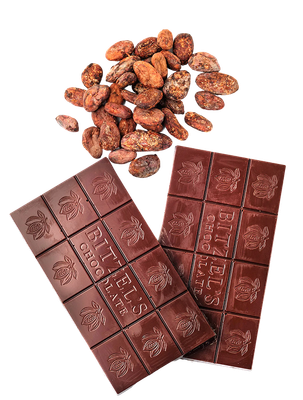
Real chocolate is made from the cacao bean and nothing that replaces it. Cacao beans are fermented, roasted, cracked and winnowed into nibs, then ground into cocoa mass (also called chocolate liquor), which is roughly half cocoa solids and half cocoa butter. Dark chocolate is cocoa mass plus sugar, and usually extra cocoa butter. Milk chocolate adds milk. White chocolate is cocoa butter, sugar and milk with no cocoa solids.

That is the whole list. The Uganda single origin bar made in our factory has three ingredients: cacao, cocoa butter and cane sugar. No emulsifiers, no preservatives. Real chocolate can carry a little lecithin as an emulsifier and vanilla as flavor, and it can carry inclusions such as nuts or fruit, but the fat in real chocolate is cocoa butter.
The legal definition of chocolate
In the United States, chocolate is a defined term. The standards of identity for cacao products sit in Title 21 of the Code of Federal Regulations, Part 163. They set minimum cocoa content for each named product and they specify the fat: for sweet chocolate, milk chocolate and the other standardized chocolates, the fat is cacao fat, meaning cocoa butter. A product that replaces cocoa butter with vegetable oil does not meet the standard and cannot be labeled simply as chocolate; it is sold as a chocolate-flavored coating, a chocolatey product or a similar descriptor.
Europe has its own rules. Directive 2000/36/EC defines chocolate, milk chocolate and couverture and sets minimum cocoa solids and cocoa butter percentages. It also permits up to 5% of six specified tropical vegetable fats in chocolate, and the pack must then read “contains vegetable fats in addition to cocoa butter.” Bitzel’s milk, white, dark, caramel, ruby and pistachio chocolate is imported directly from Europe, meeting European standards for chocolate, and our origin chocolate is roasted, milled and conched in-house. Bitzel’s uses no palm oils and no hydrogenated oils in any product.
Why this matters for a brand. If you sell a compound coating on a US pack, it needs a qualified name such as “milk chocolate and vegetable fat coating” or a descriptor like “chocolate flavored.” If you buy real chocolate, the pack can say chocolate. The word on the front of the pack is decided by the fat in the recipe.
Cocoa butter vs vegetable fat
Cocoa butter is what makes chocolate behave like chocolate. Its stable crystal form melts at around 93°F to 95°F, just below body temperature, which is why real chocolate feels cool on the tongue and then disappears. It has to be tempered, which means heating, cooling and agitating it so the right crystals form; tempered chocolate is glossy, snaps cleanly and stays stable at room temperature. In our factory that work is done by a tempering machine that holds up to 130 lbs of chocolate at a time.

Vegetable fats such as palm kernel oil, palm oil or hydrogenated oils are cheaper and do not need tempering. Coatings made with them set on their own, tolerate heat better and cost less. They also melt at a higher temperature, so they coat the mouth rather than melting away, and they carry a waxy note that most people recognize without being able to name. The trade is convenience and cost against flavor, texture and the right to the name.
Bitzel’s also uses no PGPR, the emulsifier commonly used to thin chocolate and compound coatings.
Couverture chocolate, explained
Couverture is real chocolate with extra cocoa butter. The word is French for “covering.” Under the European definition couverture chocolate contains at least 35% total dry cocoa solids, of which at least 31% must be cocoa butter, against 18% cocoa butter for ordinary chocolate. That extra cocoa butter makes it more fluid when melted, so it flows into fine mold detail, coats a truffle in a thin even shell and sets with a sharp snap and a high gloss. That is why chocolatiers and manufacturers work in couverture rather than in eating chocolate off the shelf.
Couverture is the chocolate that goes through an enrobing machine, a depositor or a mold line. In our factory the enrober runs a 400mm wide curtain of tempered couverture over pieces that then ride a 40 ft cooling tunnel for about five minutes. Because couverture is real chocolate, the finished bar, bonbon or bark is real chocolate too.
Compound chocolate, explained
Compound chocolate is a coating that replaces cocoa butter with vegetable fat. It is made from cocoa powder, sugar, a vegetable fat and emulsifiers, sometimes with milk powder. Because it has no cocoa butter to temper, it can be melted and used straight away, which is why it appears on mass-market baked goods, ice cream coatings, some protein and snack bars and many products described as “chocolatey” or “chocolate flavored.” It is a legitimate ingredient with real uses. It is not chocolate, and in the US it cannot be labeled simply as chocolate: the regulated names are “sweet chocolate and vegetable fat coating” and “milk chocolate and vegetable fat coating,” or a descriptor such as “chocolate flavored.”
The tell in the mouth is the melt. Compound coats and lingers; real chocolate melts clean. The tell on the pack is the ingredient panel, which is the next section.
How to read an ingredient panel
Ingredients are listed by weight, so the first three lines tell the story. Here is the ten-second check.
| What you see | What it means |
|---|---|
| Cocoa mass, chocolate liquor, cocoa butter, cacao, sugar | Real chocolate. Cocoa butter is present and no vegetable fat is listed. |
| Sugar first, then cocoa powder or “cocoa (processed with alkali)” | Likely compound or a low-cocoa product. Look for the fat on the next line. |
| Palm kernel oil, palm oil, vegetable oil, hydrogenated or fractionated oil | Compound coating. Cannot be labeled simply as chocolate in the US. |
| PGPR (polyglycerol polyricinoleate) | An emulsifier used to thin chocolate and coatings so less cocoa butter is needed. Not an automatic fail, but a sign of a cost-driven recipe. |
| “Chocolatey,” “chocolate flavored,” “made with chocolate” | Descriptors used when the product does not meet the chocolate standard, or only part of it does. |
| Lecithin, natural vanilla | Normal in real chocolate. Lecithin is an emulsifier; vanilla is flavor. |
The same check applies to products that make health claims. A bar that lists a vegetable oil and cocoa powder is a coated supplement, whatever the front of the pack says. Bitzel’s tests its chocolate for trace heavy metals as well, because the cacao itself, not only the fat, decides whether a product is one you can feel good about eating.
Why it matters if you are putting your name on it
For a private label or contract buyer, the cocoa butter question is a labeling question, a shipping question and a brand question at once.

- Labeling. Real chocolate can be called chocolate on the pack. Compound needs a qualified name. Decide this before the artwork is designed, not after.
- Shipping and shelf life. Real chocolate melts at a lower temperature, which is why we ship by UPS Monday to Thursday and use expedited shipping with insulated packaging when the destination is above 70°F. Shelf stable items with a 12-18 month shelf life are available.
- Taste. Your customer will taste the difference before they read the label. The clean melt is the product.
- Functional products. If your product carries collagen, protein, melatonin or another active ingredient, the base you build on decides how the finished product eats. What it can be called depends on the active ingredient and its level, which is worth settling before artwork.
Bitzel’s manufactures private label, white label and contract chocolate for other brands from a glass factory where every step of the process is completely visible. If you want to see what real chocolate looks like on a production line, start with the co-manufacturing page or take the factory tour.
Key takeaways
- Real chocolate is made from cacao, cocoa butter, sugar and, for milk chocolate, milk. The fat is cocoa butter.
- In the US, 21 CFR Part 163 defines chocolate. Replace the cocoa butter with vegetable fat and the product needs a qualified name; it cannot be labeled simply as chocolate.
- Couverture is real chocolate with extra cocoa butter (at least 31%, against 18% for ordinary chocolate under the European definition), made for molding, enrobing and depositing.
- Compound is a vegetable-fat coating. Useful, cheaper, not chocolate.
- Read the first three ingredients and look for the fat. Palm, hydrogenated or “vegetable” oil means compound.
Frequently asked questions
Is compound chocolate bad?
No. It is a coating with real uses where heat tolerance and cost matter more than melt and flavor. It is simply not chocolate, and it should not be sold as chocolate.
Is white chocolate real chocolate?
Yes, when it is made with cocoa butter. White chocolate has its own standard of identity in the US, with minimum cocoa butter and milk content. A white coating made with vegetable fat is compound.
Does “cocoa” on a label mean the same as “cacao”?
In practice yes. Both refer to the bean and its products. What matters is whether the fat listed is cocoa butter or a vegetable oil.
Can real chocolate have any vegetable fat at all?
Under US standards, no vegetable fat may stand in for cocoa butter in a food labeled chocolate; add it and the product needs a qualified name. European rules allow up to 5% of specified vegetable fats, declared on the pack. Bitzel’s uses no palm oils and no hydrogenated oils in any product.
Start Your Custom Project Co-manufacturing at Bitzel’s
Home / Blog / Couverture vs Compound: What Makes Chocolate Real