
How to Choose a Chocolate Co-Manufacturer
Bitzel's Chocolate on Oct 19th 2026
Certifications, minimums, lead times, tooling and confidentiality: the checklist for picking a chocolate co-packer you will not have to leave. A chocolate co-manufacturer, also called a co-packer or contract manufacturer, is the company that makes your product so you do not have to build a factory. Food contract manufacturing is a long relationship: molds, packaging, formulas and shelf life all live with the partner you pick. Switching later is expensive. This checklist covers the ten questions to settle before you sign, in the order a buyer usually hits them. Each one is a short section, so use the ones you need.

A chocolate co-manufacturer, also called a co-packer or contract manufacturer, is the company that makes your product so you do not have to build a factory. Food contract manufacturing is a long relationship: molds, packaging, formulas and shelf life all live with the partner you pick. Switching later is expensive. This checklist covers the ten questions to settle before you sign, in the order a buyer usually hits them. Each one is a short section, so use the ones you need.
1. Ask whether it is real chocolate or compound
The first question decides what you can print on the pack. Real chocolate is made with cocoa butter. Compound is a coating made with vegetable fat that cannot be labeled simply as chocolate in the United States. Many food co-packers run both, and the quote will not tell you which one you are getting unless you ask. Request the ingredient specification for the base chocolate and look for the fat.
At Bitzel’s the answer is on the page: we use real chocolate. Our milk, white, dark, caramel, ruby and pistachio chocolate is imported directly from Europe, meeting European standards for chocolate, and our origin chocolate is made from Ecuadorian and Uganda cacao. No hydrogenated oils, no palm oils, no PGPR. If you want the long version, read what makes chocolate real.
2. Check registration and certifications
Ask for the current status of each certificate, not the logo wall. The baseline for a US food manufacturer is FDA facility registration. Beyond that, ask which third-party food safety scheme the plant runs, whether it is certified today or in progress, and whether kosher, organic or other certifications your product needs are held by the facility.
Bitzel’s is FDA registered and OU Kosher Dairy certified. SQF food safety certification is expected March 2027 (Edition 10). Vegan, gluten free, non-GMO and USDA Organic options are available.
3. Match the minimums to your launch
A minimum order quantity that fits a national launch will bury a first run. Ask for the MOQ by format, because it usually differs between a printed piece, a stock shape and a fully custom shape with custom packaging.
Bitzel’s publishes its custom-order minimums: they vary depending on chocolate type, and range from 100 pieces for full color digital printing to 1,000 pieces for fully custom shapes and packaging; larger co-manufacturing runs are quoted per project. The company was created, in its own words, to allow any customer to obtain a true custom chocolate without insane minimum order quantities and price.
4. Get lead times in writing, including rush
Separate the three clocks: tooling, production and packaging. A quote that says “four weeks” usually means four weeks after artwork approval and after the mold exists. Ask for each stage and ask what a rush costs and how fast it is.
Bitzel’s figures: custom bars, shapes and bonbon designs usually take about 3-5 days to design and build, rush orders usually within 24 hours. Small to medium orders can be produced within 5-7 business days if no custom packaging is required. Overall, rush orders can be completed in 1 week, standard lead-times are 2-3 weeks depending on requirements.
5. Ask who pays for the mold
Tooling is where co-manufacturing quotes hide the real number. A custom chocolate mold made by an outside toolmaker is a significant one-time cost, and the partner may own it. Ask two things: what the mold costs, and whether the fee is credited against orders.

Bitzel’s builds molds in-house. The cost to design and build custom molds is a one-time fee of $525, and this fee is refunded based on order size. That is a fraction of the usual cost of $4,000 or more to build a mold, and the process is significantly faster as well.
6. Confirm formats, inclusions and shelf life
Make sure the plant can run the format you actually want, not a near equivalent. Filled pieces need a depositor. Hollow figures need a spinning machine. Panned nuts need a panning drum. Printed chocolate needs a cocoa butter printer. A partner that has to outsource a step adds time and a margin.

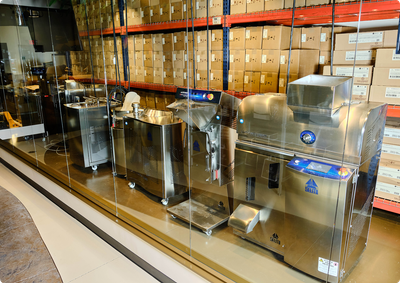
Inside Bitzel’s glass factory: filled chocolate, solid chocolate, hollow chocolate and edible printing direct on the chocolate surface, plus bars at 825 per hour on the bar line, truffles and bonbons at an average of 2,600 pieces per hour on the one-shot depositor, and panned nuts and fruits with 5-9 coats of chocolate. Shelf stable items with a 12-18 month shelf life are available.
7. Find out whether packaging is in-house
Packaging is the second factory. If your co-manufacturer ships bulk chocolate to a separate packer, you own two lead times, two minimums and two places for a mistake. Ask which packaging formats run on site and which are subcontracted.

Bitzel’s offers contract in-house packaging solutions and food labeling: rigid and folding boxes, flexible and wrap-around film, sleeves, pouches and pressure-sensitive labels, with 3D printing effects up to 11mm in height through our partnership with HP. Custom packaging can meet most design and color critical requirements in as little as 5 days.
8. Ask how your information is protected
Your formula, artwork and launch date are the most valuable things you hand over. Ask how the partner handles them and how they talk about clients publicly.
Bitzel’s position: we safeguard your information and intellectual property at every step, supporting your brand rather than competing with it. Bitzel’s does sell chocolate under its own name and says so; leading chocolate brands rely on us to stay behind the scenes.
9. Ask to see the line
A plant that will not show you the floor is telling you something. Visit if you can. Ask to watch a run, look at the tempering, the cooling tunnel and the packing area, and ask what happens to a batch that fails a check.

Bitzel’s is the first-of-its-kind glass chocolate factory, where every step of the process is completely visible, in Suwanee, Georgia, north of Atlanta. Watch as real fruits, butters, and creams go into the chocolate. We also conduct extensive testing to monitor trace heavy metals.
10. Understand how finished chocolate ships
Real chocolate melts, so logistics are part of the product. Ask what carrier is used, which days orders ship and how heat is handled in summer.
Bitzel’s ships to the contiguous United States via UPS, Monday to Thursday so orders arrive within the week. When destination temperatures exceed 70°F, expedited shipping must be used; Bitzel’s provides an insulated container and ice packs, and from late spring through summer expedited shipping is the default to most states. Volumes above parcel size are quoted separately.
Key takeaways
- Settle real chocolate vs compound first. It decides the label and the taste.
- Ask for certificate status by name and date. “Expected” and “held” are different answers.
- Get MOQ by format, lead time by stage and the mold fee, all in writing.
- Prefer a partner that molds, produces and packs under one roof. Every handoff adds time.
- Visit the floor. A glass wall does most of the work of a site visit.
Frequently asked questions
What is the difference between a co-manufacturer and a co-packer?
In everyday use, none. Co-manufacturer, co-packer, contract manufacturer and private label manufacturer all describe a company that produces a product for another brand. Some buyers reserve “co-packer” for a plant that only packages a product made elsewhere; ask which services are actually in scope.
How much does chocolate contract manufacturing cost?
It depends on the chocolate, the filling, the format and the quantity. Bitzel’s publishes two anchors: a $525 mold fee refunded based on order size, and individual chocolate pricing that usually starts around $0.40 each. Everything else is quoted per project.
Do I need my own recipe?
No. You can white label an existing Bitzel’s product in your packaging, have a product built to your specification, or bring your own formula for contract production. All three run in the same factory.
How small can a first run be?
Bitzel’s custom-order minimums range from 100 pieces for full color digital printing to 1,000 pieces for fully custom shapes and packaging, depending on chocolate type.